MONOPOLY Big Baller: Rules, RTP, Strategy & Bonus Game Guide
Watch Monopoly Big Baller
Best Online Casinos to Play Monopoly Big Baller

1Win
500% Deposit Bonus
Immersive Casino Experience
Attractive Cashback Deals
Imagine stepping into a world where the thrill of a casino meets the nostalgia of a beloved board game. Monopoly Big Baller combines these two exhilarating realms, captivating players in India and beyond. With its unique blend of chance and strategy, it opens the doors to an innovative gaming experience. This exciting game takes familiar elements from the classic Monopoly board game and infuses them with modern casino features that enhance gameplay. By incorporating innovative mechanics, and elements of bingo and lottery, Monopoly Big Baller ensures both novice and seasoned players are engaged and entertained.
Useful information
| Feature | Details |
| Developer | Evolution Gaming |
| Release Date | 2022 |
| Game Type | Live Casino Game Show |
| Main Elements | Bingo Cards, Monopoly Board, Bonus Rounds |
| Betting Options | Bingo Cards (1, 2, 3, 4), 2 Rolls, 4 Rolls |
| RTP | 96.10% |
| Platforms | Desktop, Mobile |
| Bonus Rounds | 2 Rolls and 4 Rolls |
| Unique Features | Mr. Monopoly, Virtual Monopoly Board, Multiplier Balls |
| Maximum Payout | Up to 20,000x bet поспотреть инфу |
| Languages | Multiple (English, German, French, etc.) |
What is Monopoly Big Baller?

MONOPOLY Big Baller is a live game show from Evolution that blends bingo-style card play with the spectacle of a MONOPOLY-themed studio, delivering a fast “numbers-drawn” core game plus a cinematic 3D Bonus Game. It takes the big, colorful presentation you might recognize from titles like Crazy Time or Deal or No Deal Live, then anchors it to a familiar objective: completing lines on your bingo cards.
The main round uses a 60-ball machine with 60 numbered balls, and 20 balls drawn per round. You play on a 5x5 grid card (with a center free spot on certain card types), aiming to complete lines as numbers hit. The action is hosted by an in-studio MR. MONOPOLY character, with a riverboat-inspired set and a large screen that becomes a 3D MONOPOLY board when the bonus triggers. Alongside standard card bets, you can also place 3 Rolls or 5 Rolls bets; landing the required number of “Roll” results activates the MONOPOLY Bonus Game on the bonus board.
Combining Board Game Elements with Casino Features

Monopoly Big Baller merges time-honored board game charm with modern casino thrills. The game includes classic elements like GO, Chance, and Community Chest. Mr. Monopoly navigates a 3D environment, creating a dynamic, themed gameplay experience. Traditional dice mechanics decide movement, blending familiar gameplay with exciting casino features. This combination generates nostalgic yet innovative tension. Players collect multiplier prizes as they move through a Monopoly-themed world, adding an extra layer of excitement often seen in casino games. Even those not qualifying for the Bonus Game can enjoy its spectacle, ensuring inclusive engagement.
Innovative Gameplay Mechanics
This game incorporates bingo-style mechanics where players complete lines on their cards for multiplied payouts. Augmented reality elevates the immersive experience, letting players dive deeper into the action. Mr. Monopoly takes an active role, pulling a lever to add multipliers and Free Spaces to cards, making the game more engaging. Automatic daub placement speeds up gameplay, as 20 random balls are drawn each round, offering plenty of chances to match numbers and win big.
Incorporating Bingo and Lottery Elements
In Monopoly Big Baller, players see 20 random balls drawn per round, leading to an automatic daub on matching numbers. This echoes classic bingo mechanics. The goal is to match numbers and complete lines for multiplied payouts, similar to both bingo and lottery games. Getting three or four Bonus bet spot numbers activates the 3D Bonus Game, introducing an interactive lottery-style feature. The virtual Monopoly world uses dice rolls for movement, adding a chance element like lotteries. Audience participation is encouraged, as even those outside the Bonus Game can enjoy watching the action unfold, a common bingo and lottery trait.
Key features at a glance
It’s a live, number-draw game built around simple line-completion, with optional side bets that unlock higher-volatility MONOPOLY board action. You can keep it low-key with main cards or chase bigger swings through bonus mechanics and multipliers.
- Cards & bets: Up to four main bingo cards per round, plus optional 3 Rolls and 5 Rolls side bets to target the Bonus Game.
- Card types: Choose between a Free Space card (center square pre-marked) or a Chance card featuring Chance multipliers tied to specific hits.
- Multipliers: Three layers—Standard multipliers on results, Line multipliers (e.g., 20x line, 50x line), and Global multipliers such as 2x global or 3x global that can boost multiple wins.
- Payout range: Main-game line wins commonly span 2-39x per line, with enhanced outcomes reaching 2-199x per line (up to 199x payouts).
- RTP: Published overall return is typically shown as 96.10% RTP (check your casino’s info panel for the exact configuration).
- Bonus upside: The bonus round can stack big boosts, including headline moments like a 10x multiplier or even a 20x multiplier depending on the board outcome.
Who developed the game and where you can play it
MONOPOLY Big Baller is produced by Evolution (Evolution Gaming) under official Hasbro licensing, using the MONOPOLY brand, characters, and board-game motifs. That licensing is why you’ll see familiar elements like Community Chest, Chance-style moments, and the iconic MR. MONOPOLY presentation.
You can find it at many major UK and international casino brands that carry Evolution’s live portfolio—examples include Midnite, Pub Casino, and Unibet. Availability can vary by region, so the easiest check is whether the casino’s Live Casino lobby lists it alongside other show formats like Dream Catcher or Dragon Tiger Live. Some platforms (including Evolution’s own game pages) may offer a freeplay/demo view for learning the flow, while operators such as MONOPOLY Casino typically host real-money tables in regulated markets. If you gamble, set limits and use support resources like BeGambleAware.org.
Understanding the Game Layout: Cards, Balls and Board
Basic Rules of Monopoly Big Baller
Monopoly Big Baller is an innovative live casino game that mixes traditional bingo with the beloved Monopoly board game. Its hosted live, by a presenter. Offers a mix of bingo style play and bonus rounds influenced by Monopoly. Lets delve into the rules and setup of the game.
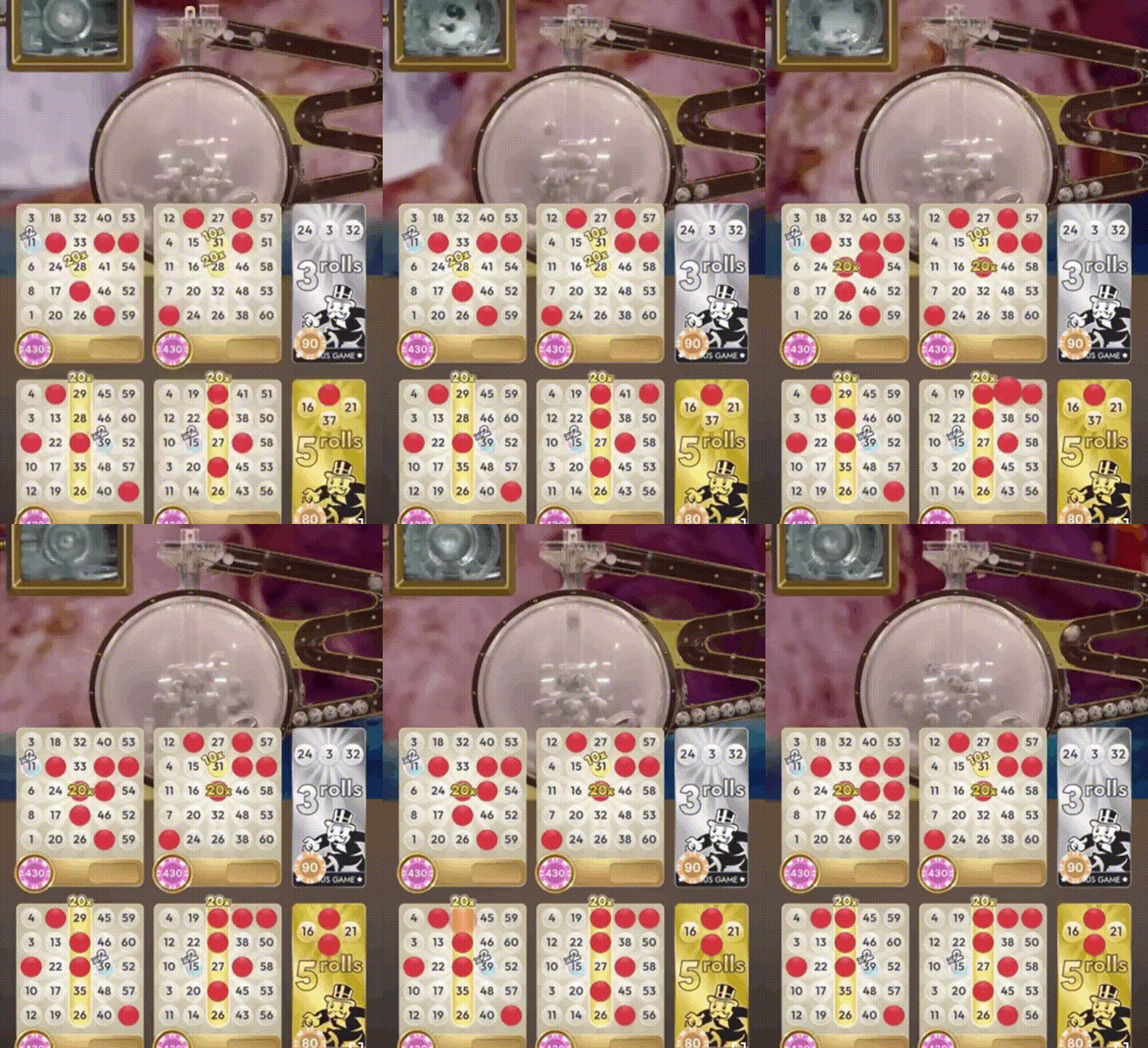
The layout is split into three clear zones: your digital bingo cards, the live ball machine, and a separate 3D MONOPOLY board that only appears for the Bonus Game. Most of the time you’re simply watching numbers land and fill your card, with MR. MONOPOLY presenting the round in a bright, riverboat-style studio.
Your main focus is the card area: each card is a 5x5 grid (a full set of 25 numbers) that acts like classic bingo, except everything is automated and displayed cleanly on-screen. To the side you’ll see the ball-draw interface and the “roadmap” style history panels common in Evolution live games; these track recent outcomes and multipliers (like 2x global or 3x global) without distracting from the core line-completion gameplay.
Bingo-style cards and bet spots explained
You can stake up to four main cards per round, then add two optional bonus bet spots that aim for the bonus-trigger outcomes. Each main card is a 5x5 grid populated with numbers from the same pool as the draw, and your exact card numbers are assigned randomly after you place your bets.
Alongside the cards, you’ll see two distinct side bets labelled 3 Rolls and 5 Rolls. These are separate from standard line wins (such as 2-39x per line in the main game) and exist specifically to unlock the 3D Bonus Game.
- Main game: Up to four cards can be active at once, each using the same 5x5 grid format.
- 3 Rolls: Triggers when you collect 3 unique numbers associated with the Roll results during the round (as described by Evolution and operator rules such as MONOPOLY Casino).
- 5 Rolls: Triggers when you collect 4 unique numbers tied to the Roll results (often higher volatility, but a more demanding requirement).
If you’re playing a Chance card variant, you may also see Chance multipliers displayed on specific squares—these can change how individual hits contribute to line value, but the basic objective remains: complete lines and chase the bonus trigger.
The 60-ball drawing machine
The main draw uses a live machine loaded with 60 balls, and the game pulls 20 drawn per game (also shown as 20 balls drawn) to determine which spaces are marked. The visuals are intentionally simple so you can track hits instantly, even when playing multiple cards.
Inside the interface, each of the 60 numbered balls (numbered 1–60) is displayed with status colors that match what’s happening on your cards. Operators following Evolution’s presentation commonly show red balls for numbers that marked at least one of your cards and grey balls for misses that didn’t appear anywhere on your active grids.
Every time a number is drawn, matching cells on your cards are filled via automatic daubing, so there’s no manual marking and no risk of missing a hit. That automation also helps when several line wins are possible at once (including higher-value patterns that can later connect to outcomes like 2-199x per line depending on the ruleset and multipliers in play).
The virtual MONOPOLY board in the bonus game
The board is a separate, animated 3D MONOPOLY board used only when the bonus triggers, shifting the experience from bingo lines to a classic property-track journey. Visually, it resembles the physical board with iconic stops and card spaces, presented as a glossy, game-show-ready set piece.
Expect recognisable spaces such as GO, Jail, Chance, Community Chest, Income Tax, and Super Tax, with the bonus token moving across them as outcomes resolve. When you land on a Chance space (or similar special tiles), the action can branch into extra events that change your bonus pacing and potential payout.
Each property on the track has attached multipliers, and at the start of the bonus round, houses and hotels are randomly added to boost those multipliers (per Evolution and common operator rule summaries like MONOPOLY Casino). This is where the biggest jumps can happen—think headline moments like a 10x multiplier stacking into a much larger total—while the main game remains centered on clean, bingo-style line completion.
Step-by-Step: How to Play a Round from Bet to Payout
A round follows a fixed rhythm: you place bets, your cards are generated, MR. MONOPOLY adds pre-draw boosts, then the machine runs through 20 balls drawn and the system pays any completed lines. If you complete a qualifying pattern, line completion equals win—with extra upside coming from multipliers or a triggered Bonus Game.
The quickest way to feel comfortable is to think in stages, because each stage is time-boxed and clearly shown on-screen (bet timer, card reveal, lever animation, ball count, then results). The overall experience is closer to a paced TV game show like Crazy Time than a traditional manual bingo room.
- Betting window: You typically get around ~12 seconds betting time to lock in stakes before the round starts.
- Card generation: Numbers populate your cards automatically once betting closes.
- Pre-draw boosts: MR. MONOPOLY pulling the lever can add free spaces and multipliers before any balls are drawn.
- Ball draw: The machine draws 20 balls; matching numbers are daubed and lines are evaluated live.
- Settlement: Payouts are calculated per line, then adjusted by any active multipliers or replaced by entry into the 3D Bonus Game if 3 Rolls/5 Rolls triggers.
| Card / bet type | Main goal | Typical line payout range | Best for |
|---|---|---|---|
| Free Space main card | Complete lines on a 5x5 card | 2–39x per line | Steadier line wins |
| Chance card main card | Complete lines with Chance multipliers in play | 2–199x per line | Higher volatility (bigger spikes) |
| 3 Rolls / 5 Rolls | Trigger the Bonus Game | Bonus entry (not a line range) | Chasing bonus-board payouts |
1. Place your bets on cards and bonus rolls
You start by choosing a stake and selecting which betting spots to activate: up to four cards for the main game, plus optional 3 Rolls and/or 5 Rolls side bets. The bet selection time limit is tight—many lobbies show roughly ~12 seconds betting time—so it helps to decide your default setup (for example, two main cards plus 3 Rolls).
At some casinos, the minimum can be very small; a commonly advertised example is a £0.10 minimum bet per spot (as shown by MONOPOLY Casino on certain configurations). That lets you spread coverage across cards without committing much per round—e.g., four cards at £0.10 each, plus £0.10 on 3 Rolls.
You can also mix card types in the same round, combining a Free Space card for consistency with a Chance card for higher-payout potential via Chance multipliers. Your stake applies per selected spot, so every extra card or roll bet increases total round cost.
2. Numbers are randomly assigned to your cards
After betting closes, each selected card is filled automatically with 1–60 numbers using random generation. Every main card is a 5x5 grid containing 25 numbers per card, and those numbers define exactly what you can hit during the draw.
Card layouts can be unique per player, not just per round. In practice, you shouldn’t assume your grid matches what another player is seeing, even though you’re all watching the same live host and draw sequence.
If you’ve placed 3 Rolls or 5 Rolls, the game also generates the required “roll” tracking cards/fields for those bets, again using randomized values tied to the same 1–60 pool.
3. MR. MONOPOLY pulls the lever: free spaces and multipliers added
Once cards are generated, MR. MONOPOLY pulls the lever to apply pre-draw modifiers—this is where the round’s personality is set before a single ball drops. You’ll see certain squares become free spaces (also described as daubs) and multipliers appear across the interface.
Daubs behave as if those numbers were already drawn, immediately improving your odds of completing a vertical, horizontal, or diagonal line. On a 5x5 grid, even one or two pre-marked squares can materially reduce how many hits you still need for a payout.
Multipliers are added before the ball draw and may include Standard boosts, Line boosts (e.g., 20x line or 50x line), and Global boosts such as 2x global or 3x global. On Chance variants, these can interact with Chance multipliers already printed onto the grid, setting up the biggest swings of the base game.
4. The machine draws 20 balls and lines are checked
The live machine releases 20 balls per round, and each result is applied instantly to your cards through automatic daubs. When a drawn number matches a square on any active card, that cell is marked without you clicking anything.
Your goal is to complete vertical/horizontal/diagonal lines on each card. Multiple completed lines on the same card stack, so it’s possible to win more than once in a single round—especially if you started with extra free spaces from the lever phase.
The interface also shows a “balls remaining” indicator, so you always know how many draws are left to finish a line. That countdown matters for pacing: early hits can turn into suspense as the last few balls determine whether you close out a second or third line.
5. Payouts applied including any active multipliers
After the draw ends, the system totals your wins per card based on completed lines—again, line completion equals win. Base line payouts follow the card type: 2–39x Free Space line range for Free Space cards and 2–199x Chance line range for Chance cards (as commonly referenced by outlets like CasinoScores and LiveCasinoComparer).
Then the game applies any active multipliers, using the rules shown in the paytable: a Standard multiplier may boost a specific win, a Line multiplier may apply to a particular completed line, and a Global multiplier can lift multiple wins at once. When several are active together, you’ll see multiplier stacking in action—e.g., a line value boosted by a 10x multiplier and then lifted again by a 2x global, depending on what the lever assigned.
If your 3 Rolls or 5 Rolls bet meets its completion condition, the round can move you into the Bonus Game instead of simply settling a fixed line win. That’s when the presentation shifts away from the bingo grid and into the 3D MONOPOLY board for the bigger, showpiece payouts.
Free Space vs Chance Cards: Which Should You Choose?
If you’re choosing between a Free Space card and a Chance card, the trade-off is simple: Free Space improves line completion frequency, while Chance pushes more of your expected value into multipliers and higher line payouts. Both use the same 5x5 grid and the same 20-ball draw rhythm, but the centre cell behaviour changes how often you’ll connect a line and how explosive wins can become.
On Free Space cards, the centre is effectively “pre-hit,” which helps you finish vertical, horizontal, and diagonal lines that cross the middle. On Chance cards, the centre is designed as a power spot for Chance multipliers, meaning a completed line through the middle can be worth far more—especially if it also catches a 20x line, 50x line, or a 2x global/3x global multiplier from the pre-draw lever phase.
How Free Space cards increase your hit rate
A Free Space card gives you a built-in head start because the centre cell free space is already filled from the moment your card appears. In practical terms, it acts as a drawn number, so any line that passes through the middle square needs one fewer matching ball to complete during the 20 balls drawn.
This is why Free Space tends to feel “busier”: you’ll see more near-misses turn into line hits, and more rounds where at least one line lands. You’re still at the mercy of the 1–60 draw, but you’ve reduced friction on the most common line paths (especially the two diagonals and the middle row/column).
Free Spaces can also be randomly added elsewhere on the grid when the lever phase assigns daubs, which further boosts line completion. The typical trade-off is that many of these wins sit in the smaller main-game range (often described as 2-39x per line), so your session can look steadier but less “spiky.”
How Chance cards boost line multipliers
A Chance card is built for bigger swings because the centre cell guaranteed multiplier turns the middle square into a payout engine rather than a simple free mark. Complete a line that crosses the centre, and that line benefits from the centre multiplier, which can compound with other assigned boosts.
You can still receive extra free-space daubs on a Chance card later (the lever can add free spaces and multipliers before the ball draw), but the feel is different: you may complete fewer lines overall, yet the lines you do complete can pay substantially more. This is the risk/reward core—more volatility, more “quiet” rounds, and occasional big hits.
On paper, that upside is reflected in the higher ceiling: Chance card line payouts up to 199x per line (often shown as 2-199x per line, per CasinoScores). When a strong centre multiplier lands alongside a 10x multiplier effect (or a line boost like 20x line), the payout jump can dwarf what you’d typically see on Free Space.
Mixing card types for balanced play
The most practical approach for many players is balanced card selection: mixing Free Space and Chance so you’re not relying exclusively on either frequent small lines or rare high-multiplier spikes. Strategy write-ups commonly recommend mixing Free Space and Chance because it smooths variance without removing your shot at the biggest line outcomes.
With four cards, a straightforward split is 2 Free Space + 2 Chance. The Free Space pair is your “hit-rate anchor,” while the Chance pair is your upside engine when multipliers line up through the centre.
- Balanced: 2 Free Space cards + 2 Chance cards, plus a small 3 Rolls side bet to take occasional shots at the 3D Bonus Game.
- Volatility-leaning: 1 Free Space card + 3 Chance cards, plus both 3 Rolls and 5 Rolls if you’re specifically hunting bonus-entry swings.
If you’re managing bankroll or playing for longer, keep stakes consistent across the four cards and treat the rolls as optional variance boosters rather than “must-add” bets. For safer play habits, set limits and use support resources like BeGambleAware.org.
Chance Multipliers: Standard, Line and Global
Chance multipliers are the random boosts added to your cards after betting closes, and they’re the main reason base-game payouts can swing from modest line hits to huge results. In practice, you’re watching for three types—Standard multiplier, Line multiplier, and Global multiplier—each applying at a different “level” (number, line, or whole card).
The key rule is that these multipliers can be stackable. A Global boost (typically 2x/3x) can multiply wins that already have a Standard (often 10x/20x) or a Line boost (commonly 20x/50x), which is how a regular 5x5 grid line can suddenly pay far beyond its normal expectation during the 20-ball draw.
Standard multipliers on individual numbers
A Standard multiplier attaches to a single numbered cell on your card—think of a specific number like “12” being tagged with a 10x multiplier or 20x multiplier. That boosted number only matters if it’s actually drawn and it sits on a line you complete.
In other words, it must be attached to a single number that becomes part of the winning line. If the ball draw misses that number, the Standard multiplier never activates, even if you complete other lines elsewhere on the card.
Simple example: if a completed line normally pays 5x and it includes a Standard 10x number, that line becomes 50x (5x base line × 10x Standard). If you complete two different lines and each contains its own Standard multiplier, each line is calculated with its relevant Standard value.
Line multipliers that supercharge specific rows
A Line multiplier is assigned to a specific full line—one row, column, or diagonal—and it pays if you complete that exact line. Typical values are 20x (a 20x line) or 50x (a 50x line), and it’s attached to a line, not to an individual number.
When that line is completed during the 20 balls drawn, the line is settled at the line-multiplier rate. You can still win on other lines on the same card at their own values; the Line multiplier doesn’t “block” additional wins.
Line multipliers can combine with Global multipliers. Example: if you complete a 20x line and your card also has a 3x global, that line effectively becomes 60x (20 × 3) before considering any other applicable boosts.
Global multipliers that affect the whole card
A Global multiplier applies across the entire card, boosting every winning line you complete on that card. The common values are 2x (a 2x global) and 3x, and they’re the most important “stacker” because they can amplify other multipliers.
Evolution’s rule text treats Global boosts as card-wide, meaning it multiplies all wins on the card, not just one line. If you hit multiple lines on the same card in a round, they all receive the Global boost.
Globals also multiply other multipliers, which is why they’re tied to the biggest base-game moments. Example: a card with a 20x line and a 3x Global pays 60x for that line, and any additional lines you complete are also multiplied by 3.
Stacking multipliers: how high can payouts go?
The biggest base-game payouts come from chained multipliers—a Standard multiplier landing on a number that’s part of a Line-multiplied row/diagonal, with a Global multiplier applied on top. Because these elements are random and conditional (the right numbers must be drawn and the right line must be completed), they don’t happen often, but they’re the reason the game feels “game-show volatile.”
It helps to separate two ideas: the typical line ranges quoted for card types versus what happens when stacks land. Sources like CasinoScores often describe line outcomes such as 2-199x per line as the top-end line payout on Chance cards, but stacked scenarios can exceed that figure when a 2x global or 3x global multiplies an already-boosted line, or when multiple boosted lines land on the same card.
No single “always true” maximum is worth memorising because the ceiling depends on what combination appears in a specific round. The practical takeaway is that stacking can push results up to hundreds of times your bet in rare cases, even though the long-run return remains anchored by the published 96.10% RTP. For safer play, treat high-multiplier chasing like a high-variance option and use limit tools and resources such as BeGambleAware.org.
All About the MONOPOLY Bonus Game (3 Rolls & 5 Rolls)

The Bonus Game is the showpiece round where the bingo-style draw hands over to a cinematic 3D Bonus Game on a 3D MONOPOLY board. You qualify through the 3 Rolls and 5 Rolls cards, then watch MR. MONOPOLY walking around the board, collecting multipliers from properties and special spaces.
Mechanically, it follows the same “move around, land on spaces, win prizes” logic players associate with MONOPOLY Live, but the trigger is different: instead of a wheel segment, your entry is earned during the 20 balls drawn phase by completing the requirements on your Rolls bets. When it hits, it’s typically the most lucrative part of the game because multiple rolls can stack multiple property multipliers, with houses/hotels boosting values before you even start.
| Bonus bet | Requirement to trigger | Rolls awarded | Can trigger together? |
|---|---|---|---|
| 3 Rolls | Three unique numbers drawn on the 3 Rolls spot | 3 rolls (plus extras for doubles) | Yes, can trigger in the same base round |
| 5 Rolls | Four unique numbers drawn on the 5 Rolls spot | 5 rolls (plus extras for doubles) | Yes, resolves sequentially if both trigger |
Triggering the 3 Rolls and 5 Rolls bonus cards
You enter the bonus by completing the dedicated Rolls bet spots during the main draw. The 3 Rolls bet requires three unique numbers to be drawn on its spot, while the 5 Rolls bet requires four unique numbers to be drawn on its spot.
Before any of the 20 balls drawn, the game can also add additional free spaces (daubs) to these Rolls spots, which effectively gives you “pre-hit” numbers and improves your chance of qualifying. This is similar in spirit to free daubs on the main 5x5 grid, except it’s focused purely on unlocking the board round.
You can trigger either bet, or even both in the same round. If both qualify, you’ll play sequential bonus games one after the other (one board run resolves, then the next begins), each calculated from its own triggering bet amount.
How MR. MONOPOLY moves and collects prizes
Once you’re in, the bonus is driven by dice movement and accumulation. For each roll you earned (3 or 5), two dice are rolled and MR. MONOPOLY walking around the board advances the total number of spaces shown.
Every property space has a multiplier attached to each property, and landing on that property adds its multiplier to your collected prizes (multiplied by your triggering bet). At the start of the bonus, houses and hotels are randomly placed on properties to raise those multipliers, so the board can be “juiced” differently every time.
Doubles are especially valuable: if you roll a double, you get an extra roll for doubles (as described by operator rules like MONOPOLY Casino), extending the bonus and giving you more chances to land on boosted properties. Example: if you start with 3 Rolls, roll 4+4 (double 8) to land on a property and collect its multiplier, you immediately gain an extra dice roll and continue building a larger total.
Board events: GO, taxes, Jail, Chance and Community Chest
Special spaces can swing the bonus in ways that feel very “MONOPOLY,” and they’re a big reason the board round can outshine base-game line wins like 2-39x per line. Some events increase your total dramatically, while others shave winnings down if you’re already ahead.
GO doubles prizes: if you pass GO during your movement, all board prize values are doubled going forward, which can turn a modest property collection into a much bigger finish. Taxes are the main “risk” events: 10% Income Tax and 20% Super Tax can be charged from your current bonus winnings (only if you have enough accumulated for the deduction to apply).
Go to Jail sends MR. MONOPOLY straight to Jail, and you must roll a double to exit on a subsequent roll. Your previously collected prizes remain safe while you’re stuck, but being in Jail can consume rolls that would otherwise land on properties.
Chance and Community Chest introduce random rewards or fees—think “Chance space” outcomes that can add a cash-style prize, remove a slice of winnings, or create a sudden swing similar to the surprise moments that make live shows like Crazy Time or Deal or No Deal Live feel unpredictable.
What happens when the bonus game ends
The bonus ends after you’ve used all allocated rolls plus any extra rolls earned from doubles. At that point, the system totals everything you collected and shows a single total payout credited to you based on the combined multipliers and events.
If MR. MONOPOLY is still in Jail when your final roll is spent, it doesn’t wipe out your progress—your earlier wins remain intact (per MONOPOLY Casino-style rule summaries). When both 3 Rolls and 5 Rolls triggered in the same base round, you’ll see the games resolve in sequence, with each bonus run calculated and credited separately before returning to the next betting phase.
RTP, Odds and Payout Ranges
The key stats are straightforward: the published theoretical return for MONOPOLY Big Baller is 96.10% RTP, with line wins typically falling into two different ranges depending on whether you play a Free Space or Chance card. Evolution shows RTP and pay information in-game, and third-party explainers like LiveCasinoComparer highlight the same headline figures—but remember that RTP describes long-term averages, not what you’ll experience over a short session.
Because the game runs on a 20 balls drawn format from a 1–60 pool, short-term results can swing hard around the average. Variance gets even sharper when pre-draw Chance multipliers (like a 2x global or 3x global) and bonus entry via 3 Rolls or 5 Rolls are involved, since they concentrate more value into fewer, bigger outcomes.
Base game line payouts on Free Space and Chance cards
Base-game payouts are calculated per line, and the card type determines the line table before any multipliers are applied. In simplest terms, Free Space cards lean toward smaller, more frequent line payouts, while Chance cards offer fewer but potentially much larger line payouts.
For a Free Space card, the line table generally pays 2–39:1 per line (often written as 2-39x per line). For a Chance card, the line table generally pays 2–199:1 per line (also seen as 2-199x per line) before considering Standard/Line/Global multipliers.
Payouts also scale with the effect of multiple lines on the same card. For example, completing one line might pay a small multiple, while completing three lines on that same 5x5 grid in a single round stacks those line wins together—then any active boosts (like a 20x line or 10x multiplier on a key number) are applied according to the rules shown on-screen.
House edge and volatility considerations
96.10% RTP translates to a theoretical 3.90% house edge (100% − 96.10% = 3.90%). That’s an average across huge numbers of rounds; it isn’t a promise that you’ll “get back” 96.10% in any particular hour of play.
Your actual session feel is driven by volatility and variance. Free Space cards tend to generate more frequent line hits because the centre is effectively pre-marked and extra daubs can appear, but those wins often sit in the lower range. Chance cards can run colder, yet when multipliers stack—say a boosted line plus a 3x global—your payout can spike dramatically.
Leaning heavily into 3 Rolls and 5 Rolls usually increases variance even further. The Bonus Game on the 3D MONOPOLY board can be lucrative, but it’s also naturally swingy: you may miss triggers for several rounds and then hit a large payout when board multipliers align. If you’re managing bankroll, set a budget, pace stakes per round, and use safer-gambling tools and resources like BeGambleAware.org.
Basic Strategy Tips for New Players
The best “strategy” in MONOPOLY Big Baller is really about managing variance and choosing a setup you can comfortably repeat—there’s no system that beats the built-in odds. If you focus on bankroll management, mixing card types, and keeping realistic expectations around the 96.10% RTP, you’ll make better decisions round-to-round without falling into the trap of overbetting when the game feels exciting.
LiveCasinoComparer and OLBG-style advice tends to land on the same themes: spread risk across a sensible number of cards, treat 3 Rolls/5 Rolls as optional variance boosters rather than mandatory plays, and avoid emotional betting. Most importantly: not chasing losses matters more here than in many table games because the 20 balls drawn format plus multipliers can create long stretches of nothing, followed by sudden spikes.
Choosing how many cards and bonus bets to play
The right setup depends on how much volatility and cost you’re comfortable with, because every extra card increases total stake. The common LiveCasinoComparer-style question—“do you play all cards or just a few?”—has a practical answer: more cards means more coverage and more chances to hit a line, but you pay for that extra action every round.
If you play 1–4 cards, you’re deciding how many 5x5 grids you want in play during the same 20 draws. With four cards, you’ll see more frequent small returns (simply because more lines can complete), but your total bet per round is also the highest.
- 1–2 cards: Lowest cost, simplest to follow, but fewer chances to land a boosted line.
- 3 cards: A strong middle ground for beginners—more coverage without the full cost of four.
- 4 cards: Maximum action, maximum spend; best reserved for when your budget supports it.
For the bonus, there’s a similar trade-off between cost and coverage: playing 3 Rolls and/or 5 Rolls every round increases your shot at the 3D Bonus Game, but also increases swinginess and burn rate. A beginner-friendly starting point is 2–3 cards plus one bonus bet (often 3 Rolls), then adjust based on how fast your balance moves.
Managing your bankroll and setting limits
Good responsible gambling habits matter more than “picking the right card,” because this game is designed to be high-energy and occasionally high-variance. Start by setting a session budget you can lose without stress, then decide your per-round stake size so you’re not forced into all-or-nothing decisions after a cold streak.
A practical approach is to keep your total per-round stake around 1–2% of your session budget. For example, with a £50 budget, aim for roughly £0.50–£1.00 total per round across all cards and any 3 Rolls/5 Rolls bets. That pacing gives you room for variance and helps you actually experience the multipliers and bonus rounds without going broke quickly.
- Don’t increase stakes aggressively after losses; that’s the fastest route to tilting.
- Plan breaks (timer or fixed number of rounds) because the game-show pace makes it easy to autopilot.
- Keep realistic expectations: a 96.10% RTP is long-run math, not a short-session promise.
If you feel you’re betting emotionally or trying to win back losses, stop—not chasing losses is the single most important skill for live bonus-style games. If you need support or tools, use operator limit settings and resources like BeGambleAware.org.
Leveraging multipliers without overexposing yourself
Big wins usually come from the multiplier layer—Standard, Line, and Global multipliers—but the mistake is “chasing multipliers” by suddenly staking far above your normal size. Because multipliers are randomly assigned and still require the right numbers to land, you can easily overpay for a moment that never converts into a completed line.
Instead, let multipliers come to you through structure. A simple way is mixing a Free Space card (more frequent line hits in the 2-39x per line range) with a Chance card (higher upside up to 2-199x per line when Chance multipliers connect through the centre). This keeps your baseline steadier while preserving access to spikes like a 20x line or a stacked 3x global situation.
If you see a strong setup appear (say a 20x line on one of your cards), treat it as entertainment value rather than a signal to double your bets next round. The risk vs reward only works in your favor when your stake sizing stays consistent.
Advanced Tactics: Card Selection and Bet Spreading
Once you understand the flow, the real edge is discipline: which cards should you play? and how you should spread your bets so you can survive dry spells and still have exposure to the biggest swings. You can’t influence the 60 numbered balls or the 20 balls drawn, but you can control where your money goes: main cards for steadier line frequency, and 3 Rolls/5 Rolls for higher-variance access to the 3D Bonus Game and the 3D MONOPOLY board.
Think of your total stake as a portfolio. A common advanced approach is using a consistent split (for example, 60% main cards, 40% bonus) and only adjusting within tight bounds, rather than reacting to recent results or “hot” rounds. That keeps your decisions aligned with the game’s fixed 96.10% RTP instead of your emotions.
| Allocation style | Main cards share | Bonus rolls share | Typical goal |
|---|---|---|---|
| Line-first | 80% | 20% | More frequent base-game hits (2-39x per line typical) |
| Balanced | 60% | 40% | Regular line action plus meaningful Bonus Game exposure |
| Bonus-leaning | 40% | 60% | Chasing board swings (higher variance) |
Targeting specific card layouts or accepting randomness
Some interfaces let you refresh or switch card types (e.g., toggling between a Free Space and a Chance card) before the betting window closes, which can feel like you’re “choosing” a better setup. In reality, the numbers that fill each 5x5 grid are still determined by randomness, and you’re not selecting from a fixed shoe or a predictable sequence.
Players often gravitate toward cards that “look right,” such as layouts with more central coverage or a pleasing spread across the 1–60 range. That’s understandable, but there’s no change to RTP from picking a layout that seems more evenly distributed; the underlying draw is the same, and the card population is randomised after bets.
A more productive way to use switching is strategic, not cosmetic: pick Free Space when you want more frequent line completion, and pick Chance when you want more exposure to Chance multipliers and higher ceiling lines (especially when a 2x global or 3x global shows up on your card). If you find yourself burning time refreshing to “find the perfect card,” you’re usually just increasing decision fatigue without improving outcomes.
Allocating your stake between main cards and bonus rolls
Advanced staking is mainly about controlling variance while keeping access to the board round. Main cards can deliver multiple lines per round (with outcomes influenced by Standard and Line boosts like a 20x line or 50x line), while bonus rolls are a separate path to the most cinematic payouts.
The key practical difference is frequency versus value: 3 Rolls is generally easier to trigger than 5 Rolls, while 5 Rolls is typically rarer but more lucrative because it awards more rolls on the board and therefore more chances to collect property multipliers (plus extra rolls from doubles). Your job is to decide how much you’re willing to pay for those rarer entries.
- Balanced every-round bonus exposure: If your base unit is £1.00 per round, you might place £0.60 on cards (e.g., three £0.20 cards mixing Free Space/Chance) and £0.40 on bonus (e.g., £0.20 on 3 Rolls + £0.20 on 5 Rolls).
- Concrete example split: Four cards at £0.50 cards total per round (e.g., 2×£0.25) plus £0.25 on each bonus (3 Rolls and 5 Rolls) creates a steady base-game footprint while keeping both triggers “alive.”
- Pulsed bonus strategy: Play main cards every round, but only add 5 Rolls once every 3–5 rounds to reduce spend while still giving yourself periodic high-upside shots.
Whatever split you choose, keep it consistent for a meaningful sample of rounds; changing it every time you miss a bonus is just another form of chasing. If you’re prone to overextending during high-energy live games (the same trap players hit in Crazy Time-style formats), cap your maximum per-round stake and stick to it.
Live Stats, Results Trackers and Data Tools

Several third-party tools publish live-ish dashboards for MONOPOLY Big Baller, showing recent outcomes, bonus triggers, and how often certain multipliers have appeared. Popular examples include the CasinoScores live feed (often surfaced via in.casino.org) and LiveCasinoComparer pages that summarise recent game activity.
The most recognisable format is a page titled Monopoly Big Baller Game Statistics and Results Tracker, which aggregates recent results into an easy timeline. You’ll typically see things like when 3 Rolls or 5 Rolls last triggered, whether a 3D Bonus Game occurred recently, and snapshots of notable multipliers (for example a 2x global or 20x multiplier) from recent rounds.
Used correctly, these trackers are helpful for understanding pace, volatility, and what “normal” looks like over a session. Used incorrectly, they can reinforce the gambler’s fallacy—the belief that a bonus or big win is “due” because it hasn’t shown up lately.
What live result streams can (and can’t) tell you
Live result streams can show patterns in recent history, but they cannot predict future outcomes. Even though the game uses a fixed structure (a 5x5 grid, 20 balls drawn, and bonus triggers tied to roll-bet numbers), each round is designed to be a fresh event rather than a continuation of the last one.
Most trackers let you filter by time windows such as past 1 hour / 6 hours / 24 hours, which is useful for answering questions like “How frequently has 5 Rolls appeared today?” or “How many bonus rounds fired in the last hour?” You may also see summaries of big moments, like unusually strong Global stacks, big line payouts on a Chance card (up to the 2-199x per line band), or a run of rounds without notable multipliers.
What those streams can’t do is tell you that a 5 Rolls trigger is “about to happen.” Rounds are treated as independent rounds, and the next set of 60 numbered balls and assigned multipliers doesn’t become more likely just because the last hour looked quiet. If you use trackers at all, treat them as a context tool (volatility awareness and entertainment), not a signal—otherwise you’ll end up chasing perceived “due” events and betting outside your plan.
Where to Play the Game Online
You’ll typically find MONOPOLY Big Baller at licensed, regulated online casinos that carry Evolution’s live game-show portfolio. That includes brand-led options like MONOPOLY Casino as well as broader UK/EU-facing operators that list the game inside their Live Casino lobbies alongside titles like Crazy Time, Dream Catcher, and Deal or No Deal Live.
Availability depends on your location and the operator’s agreements, so the same casino brand may offer the game in one country but not another. Examples commonly seen in comparison listings include Midnite, Pub Casino, Unibet, and, in wider international lineups, brands such as Duelz Casino and Dream Vegas. Before depositing, check that the site is properly regulated in your jurisdiction, that live casino is permitted where you live, and that the operator clearly displays its licensing information and safer gambling tools (for UK players, support resources like BeGambleAware.org are a good reference point).
Comparing welcome offers and wagering requirements
Welcome offers can look generous on paper, but live game shows don’t always qualify the same way slots do. Many casinos apply live casino bonus restrictions, meaning games like MONOPOLY Big Baller may be excluded from wagering entirely or count at a reduced percentage toward clearing a bonus.
Always read the terms for wagering requirements (often expressed as a multiple like 30x), and check whether the casino defines separate rules for live games. Two key details are game contribution (for example, live games contributing 0%–20% toward wagering) and any maximum bet limits while a bonus is active, which can be easy to breach in fast-paced rounds when you’re selecting multiple cards plus 3 Rolls or 5 Rolls.
Also confirm game eligibility by category: some terms treat “live bingo-style” or “game shows” differently from live blackjack/roulette. If the contribution is low or exclusions are broad, you may be better off treating the offer as a slots-only perk and playing the live game with cash stakes you’ve already budgeted, rather than trying to force a bonus clear in a high-variance format.
Desktop, Mobile and Freeplay Options
You can play MONOPOLY Big Baller on desktop, tablet, smartphone through most casinos that carry Evolution’s live lobby, with the interface automatically scaling to touch screens. On mobile, you’ll still see the core elements—your 5x5 grid cards, the 20 balls drawn animation, and the 3D Bonus Game when it triggers—just arranged into a more vertical layout.
In some jurisdictions, the Evolution Games freeplay demo is also available, letting you watch rounds and place pretend bets to learn pacing and rules. That’s different from random “Monopoly Big Baller” style downloads in app stores: there are also non-casino 'Monopoly Big Baller' inspired mobile games (often dice- or racing-themed) that may borrow the name/idea but aren’t the licensed, real-money live casino product and won’t use Evolution’s studio or the same bonus-board mechanics.
| Option | Where it’s found | Money at risk? | Best use |
|---|---|---|---|
| Real-money live casino | Licensed operators (Evolution live lobby) | Yes | Actual wagering and withdrawals |
| Evolution Games freeplay demo | Evolution’s official game pages (availability varies) | No | Learn cards, multipliers, 3 Rolls/5 Rolls flow |
| “Inspired by” mobile apps | App stores (not the live casino title) | Usually no (or different monetisation) | Casual entertainment, not practice for real odds |
Playing for free vs real money
A freeplay demo is for practice and entertainment only: you can click through card selection, see how 3 Rolls and 5 Rolls triggers work, and watch how multipliers like 2x global or a 20x line would apply, but you can’t win or lose cash. Demos are ideal for understanding the rhythm of the game—betting timer, card generation, lever phase, and settlement—without pressure.
Real-money play requires a funded account at a licensed, regulated casino, and you should expect identity checks. Most operators will require KYC (Know Your Customer) verification before withdrawals, and some will request it earlier depending on local rules and payment methods.
If you’re new, the smartest approach is to practice before playing for cash. Use demo mode to learn what a “normal” round looks like, how often you tend to hit base-game lines, and how volatile bonus entry can feel—then set limits if you switch to real stakes. For safer gambling support and tools, keep resources like BeGambleAware.org in mind.
Related Evolution Game Shows You Might Enjoy
If you like the mix of studio showmanship and big-swing payouts, Evolution’s live lobby has several neighbouring titles that scratch a similar itch. Some lean into board-game mechanics (like MONOPOLY Live), some are ball-draw hybrids (like Mega Ball), and others are pure game shows or classic table formats with multiplier overlays (like Lightning Roulette).
As a rule, wheel/game-show titles (such as Crazy Time and Deal or No Deal Live) feel more “event-driven,” while draw-and-mark games feel more systematic round-to-round. Volatility varies widely: some games offer frequent small hits, while others cluster value into rare bonus events or extreme multiplier outcomes.
- Crazy Time / Crazy Coin Flip: High-energy wheel formats built around bonus rounds and occasional huge multipliers; typically higher volatility than most ball-draw games.
- Deal or No Deal Live: A pick-and-reveal bonus structure where the big moments are concentrated in fewer outcomes; sessions can swing hard.
- Dream Catcher: A lighter wheel game with simpler segments and generally lower intensity than Crazy Time, often used as a “cool-down” option.
- Lightning Roulette / XXXtreme Lightning Roulette: Classic roulette with randomly struck “lightning” numbers that can pay boosted multipliers; volatility depends on whether you’re hunting the lightning hits.
- Dragon Tiger Live: A fast, simple comparison game (Dragon vs Tiger) with a lower learning curve, but still subject to streaks and variance.
- Football Studio Dice: Dice-based outcomes with fast rounds; closer in feel to betting on a quick event than building across a board.
Comparing this title to MONOPOLY Live and Mega Ball
The closest “family members” are MONOPOLY Live and Mega Ball, but they get to big payouts in different ways. MONOPOLY Big Baller and MONOPOLY Live share the iconic 3D MONOPOLY board idea for the Bonus Game, including familiar spaces like Chance and Community Chest; the difference is how you enter it.
MONOPOLY Live is a wheel-driven game show: you bet on wheel segments and bonus options, and the spin determines whether you go to the board or other bonus mechanics. By contrast, Big Baller is bingo card-driven: you’re completing lines on a 5x5 grid while 20 balls drawn are pulled from 60 numbered balls, and you typically access the bonus via 3 Rolls or 5 Rolls triggers.
Mega Ball sits between the two: it’s also a live ball-draw game, but it uses a different structure (commonly a 1–51 ball set) and its headline upside comes from the Mega Ball multiplier concept, where a special ball can apply a large multiplier to certain bets rather than focusing on bingo-line completion plus Standard/Line/Global boosts. In short: choose MONOPOLY Live if you prefer wheel suspense, Mega Ball if you like draw-based multipliers, and Big Baller if you want the combination of line-chasing plus board-game bonus potential.
Frequently Asked Questions
These quick answers cover the most common practical questions players ask about rules, RTP, ball draws, and the bonus board. Use them as a fast reference if you’re comparing this live title to other Evolution game shows.
What is MONOPOLY Big Baller by Evolution?
It’s a live game show from Evolution that combines bingo-style line completion with MONOPOLY-themed multipliers and a 3D board bonus round. You play on 5x5 cards while balls are drawn live, then multipliers can boost your line wins or help trigger the board feature. The MONOPOLY branding is used under Hasbro licensing.
What is the RTP of this game?
The theoretical RTP is 96.10%, as shown in Evolution’s game info and repeated across multiple casino guides. RTP (Return to Player) is a long-run statistical average of how much is paid back over many rounds, not a guarantee for any single session.
How many balls are drawn each round?
Each round uses 60 total balls (numbered 1–60), and exactly 20 balls are drawn every time. That draw count is fixed, regardless of whether you bet one card or four cards plus 3 Rolls/5 Rolls.
Can I really win big on the bonus board?
Yes—your biggest spikes typically come from the bonus game on the 3D board, especially when you collect high multipliers, pass GO, and land on boosted properties. Global multipliers can also amplify totals when they stack with other bonuses. It’s rare but possible, and the house still keeps an edge overall.
Do all players share the same numbers and outcomes?
The live elements—ball draws and the on-show multiplier/lever events—are shared, so everyone watches the same 20 balls come out of the machine. However, guides such as LiveCasinoComparer indicate that card layouts may vary by player/round because your 5x5 grid is generated after you bet. In practice, you and another player can see different card numbers even while the same drawn balls and multipliers are being presented.
Is there a guaranteed winning strategy?
No—there’s no guaranteed system that can overcome the game’s house edge over time. You can improve your experience by managing volatility (mixing Free Space and Chance cards, controlling stake size, limiting bonus-roll spend), but any method promising guaranteed profit is misleading. Keep play responsible and use tools like deposit limits or support resources such as BeGambleAware.org if needed.
Responsible Gambling and Final Thoughts
MONOPOLY Big Baller is built to be a fast, polished live show—fun visuals, big sound cues, and the occasional “wow” moment when a 10x multiplier lands or the 3D Bonus Game fires on the 3D MONOPOLY board. It’s still a casino product with a house edge (the published 96.10% RTP is a long-run average), so the safest mindset is entertainment-first, not income-first.
| Enjoyment feature | What makes it exciting | What to watch out for |
|---|---|---|
| Multipliers | Big spikes from Global/Line boosts (e.g., 2x global, 20x line) | Can tempt you to increase stakes “just this round” |
| Bonus entry | 3 Rolls / 5 Rolls can unlock the board and stacked rewards | High variance; long gaps between triggers are normal |
| Fast pacing | 20 balls drawn per round keeps action moving | Easy to lose track of time and spend |
The most effective protection is simple: set limits before you start (time, loss, and deposit limits), keep your stake size consistent, and avoid upping bets after a cold stretch. Variance is part of the design—especially if you’re mixing a Chance card with bonus bets—so stop when it isn’t fun rather than trying to “get even.”
If gambling starts to feel stressful, secretive, or hard to control, take a break and reach out for support. Evolution and many licensed casinos point players toward help resources such as BeGambleAware.org, where you can find practical tools and confidential guidance.